
Trace Previous Jackson County Owners Backward
Work from the newest matching deed backward. The current grantee on that instrument names the grantor you search next. That person, found as an earlier grantee, hands you the prior link. Accept the loop only when the legal description and parcel reference agree. The dates, book, and page must match as well.
| Transfer point | Grantor to grantee | Deed evidence | Citation to save |
|---|---|---|---|
| Newest | Current seller to current grantee | Newest matching conveyance | Date and book/page |
| Prior | Earlier seller to that seller | Acquiring deed named by index or deed | Prior-deed reference |
| Earlier | Repeat for the same tract | Older deed book or estate instrument | Book, page, parties, legal description |
Jackson County's recorded chain lives in the Clerk's deed books. The GSCCCA Real Estate Index opens those books to online searching. The index covers grantor, grantee, book/page, and plat modes. Dig into tax digests, old newspapers, and archives for leads, too. A deed itself still beats any of those. Only a recorded conveyance proves a chain link.
The statewide landing page gathers every index mode in one place:
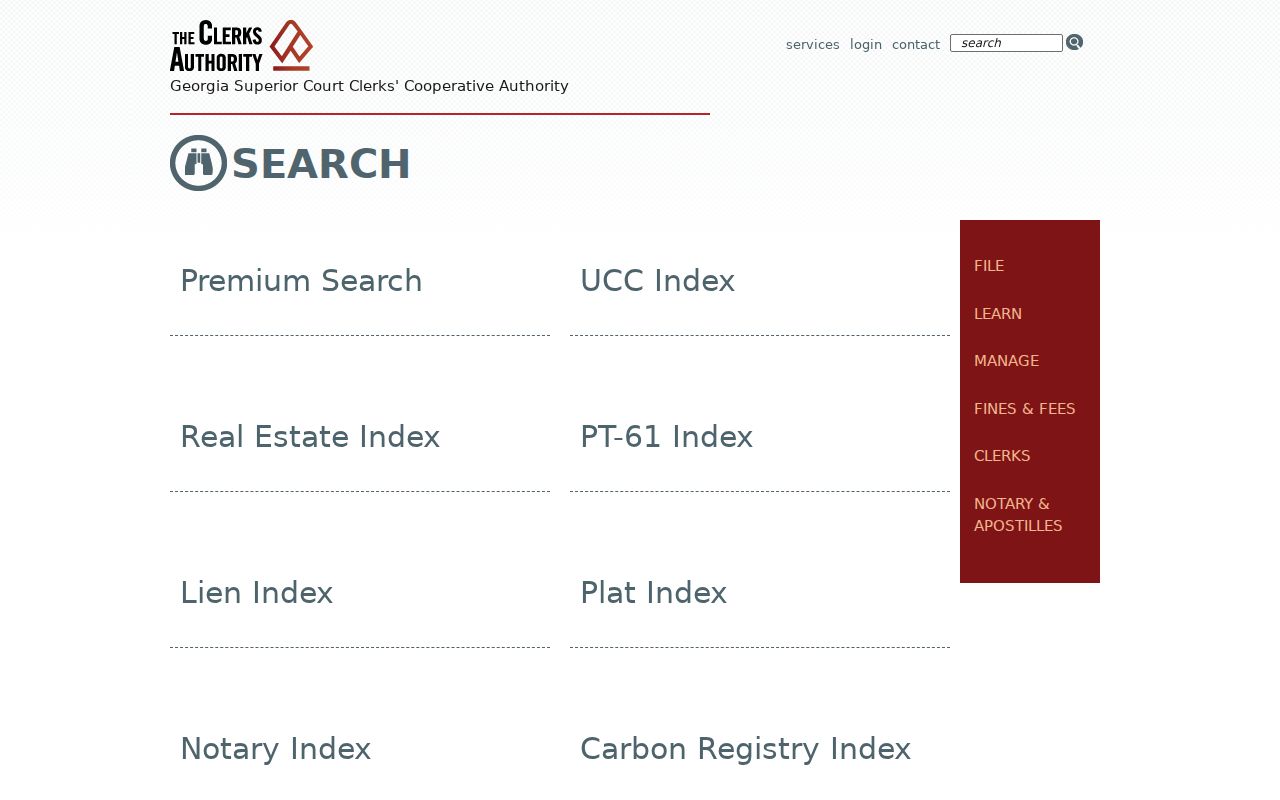
That landing page is only the doorway. A prior-owner link counts for Jackson County property records only when the instrument and land description both match the subject parcel.
Use Jackson County's Verified 1988 Image Line
Per the Clerk, Jackson County real-estate records go back to 1796. Digital images tell a shorter story. On the public terminal, they reach January 1988. Older books are still being imaged. The online GSCCCA index has no single published start year.
Search online first. Then use the Clerk's terminal for the verified 1988-forward image run. When a chain reaches deeper than 1988, ask staff to pull the older book. Just don't call 1988 the first deed year. Don't assume every online image goes back that far.
Time-depth limit. January 1988 is the verified terminal image line. Earlier owners require deed books, Clerk help, or archival leads.
Keep Every Jackson County Chain Link Identifiable
GSCCCA gives you name, book/page, and, where enabled, property search controls. For any Jackson County property search by owner, run grantor and grantee names in separate passes, and test initials, spelling variants, married names, and full entity wording before you conclude a name is absent from the deed records.
- Grantor
- The party conveying an interest.
- Grantee
- The party receiving an interest.
- Reverse index
- A grantee-oriented route to an acquiring deed.
- Chain of title
- The linked conveyances for the same land.
- Warranty or quitclaim
- Different deed forms whose effect must be read in the instrument.
Save party role, instrument type, dates, book/page, image status, and cross-references for every Jackson County match.
A same-name result is only a candidate until the land matches the parcel.
Reconstruct Jackson County's Prior-Owner Chain
Start with the current assessor owner for one purpose only. That purpose is locating the newest deed in the Jackson County property records. That deed drives everything after it. Let the recorded instruments build the chain backward on their own terms. Older books rarely know the present street address. So lean on the legal description and the prior-deed clause inside each instrument instead.
- Record the newest deed's parties, date, book/page, and complete legal description.
- Search that grantor as a grantee to locate the earlier acquiring deed.
- Match subdivision, lot, block, phase, acreage, map reference, and prior-deed clauses.
- Repeat the reversal, noting splits, combinations, estate instruments, and changed road names.
- Parent tract
- The larger tract from which a later lot was created.
- Legal description
- The land wording used to prove each deed concerns the same property.
- Book and page
- The recording location that lets the next researcher retrieve the instrument.
A simple personal-name chain can break quietly. An executor's deed, an administrator's deed, a distribution, or a court order may redirect Jackson County title through probate. Search probate only when the property records themselves point there.
Search Jackson County Parent Tracts Before Modern Lots
A modern subdivision lot may descend from older land. It may sit in Jackson County records under a different road, owner, or development name. Chase the plat book and page, phase, lot and block, and parent tract. Also chase every prior conveyance citation the deed records mention.
Combination plats sometimes retire old boundary lines. The land itself stays traceable.
Traditions of Braselton Phase I ties 37 lots to Georgia Highway 124 and GMD 248/245. The plat sits in Plat Book 69 page 15. The deed records also cite the former Mulberry Plantation name. Treat that earlier name as a search lead for Jackson County property records, not as an ownership transfer.
Continue Jackson County Owner History at the Historic Courthouse
Ownership trails often predate anything online. The Historic Courthouse Archives is the essential stop in Jackson County. Its shelves hold tax digests from 1797 through 1970. The same stacks also hold mortgage material, probate estates, court books, maps, and family files. Hours run Monday through Thursday, 9 a.m. to 4 p.m. A quick call to 706-387-7684 saves a wasted trip.
The archive itself carries a dramatic story. A recovery project once budgeted for two weeks stretched into fourteen years. It filled 635 boxes holding more than 25,000 folders. So an old Jackson County property records trail may sit safely in a folder. It may never surface digitally. Treat the archive as your context. The Clerk's deed records remain the legal checkpoint.
Search Commerce's Harmony Grove Names in Old Owner Records
Commerce keeps a second, older doorway into Jackson County property records. The Commerce Digital Archives covers deeds from 1846 to 1875. It also holds chattel mortgages from 1881 to 1901. The town was Harmony Grove first. That older name still lives on in Harmony Grove Mills and the Harmony Grove Echo. So deeds and notices can carry either version.
Run a property search under both place names. Include every personal-name variant and the parent tract behind the parcel. A single legal notice or archive deed can yield a book number, date, estate, or road clue worth chasing. Verify each lead against the Jackson County Clerk's official deed records.
Note: Historic occupants, taxpayers, and newspaper subjects are clues; they are not automatically previous owners of the recorded parcel.
Bridge Jackson County Estate Transfers Carefully
Estate transfers are where many Jackson County ownership chains wobble. A death record proves the owner died. Probate proves who gained authority. Only a deed, distribution, or court instrument actually moves the land-record chain forward. The Probate Court and the Historic Archives both hold wills, estate administration, year's support, and guardianship material that Jackson County property records alone may not show.
Search for executor, administrator, estate, survivorship, quitclaim, distribution, and heir wording throughout the deed records. Save every case number and instrument reference as you go. Resist the urge to declare that a will alone vested the next owner of record. Capacity and the legal description must line up before a link counts as proven.
Test Jackson County Prior Owners Against the Plat
A Jackson County ownership chain can look unbroken by name. Quietly, though, it can drift onto another tract. At every link, compare acreage, land lot, district, subdivision, lot, block, phase, adjoining land, and the plat citation. Watch parent-tract conveyances closely. If a deed covers the full parent tract, note the later plat. It carved out the subject lot.
Dry Pond Acres shows why detail pays off. Its record identifies map 065A 043, 815 Silver Dollar Road, lots 2A through 2C, plus road rights-of-way, improvements, and utility and drainage features. Facts at that level separate a true predecessor from a same-name stranger down the road.
Probate can interrupt a chain. When no online index resolves the gap, request the existing non-exempt estate file by decedent and date range. Hunt for appointment, inventory, order, and distribution references there. Then return to the real-estate index and trace forward from the estate or the heirs.
Work through former owners in order. A silent jump over a missing deed should stop you. A name that turns up in a tax digest or a newspaper story is only a lead until a recorded conveyance matches the land. Aliases and entity names need the same legal-description test. That discipline keeps prior-owner work tied to Jackson County's recorded property records.
The Clerk of Court keeps the deed records at 5000 Jackson Parkway, Suite 150, in Jefferson, open weekdays from 8 a.m. to 5 p.m. Bring names, dates, parcel references, and any book/page. For pre-1988 material, ask staff which physical book or archive channel applies; a missing image is not a missing deed.
A tax digest can place a taxpayer on land in a given year, and newspapers may reveal an estate sale, a road alias, or a subdivision advertisement. These clues shape the next index search. They never prove title to today's exact parcel.
Annexation complicates municipal edges. Keep the deed chain separate from zoning history, because annexation only changes which planning office holds a file. Braselton spans four counties, so its deeds may sit in a neighboring county's recorder. Establish the county from map geometry, then follow that county's property records.
Know How Far Jackson County Ownership Records Go
Unrecorded claims, badly indexed names, tract splits, and instruments filed under an estate can all hide a true owner of record. Annexation is not a conveyance. A city boundary change creates no new owner either. Keep every document citation so gaps stay visible. When you need a copy, Jackson County charges $0.50 per page, and certified copies start at $2.50 for the first page plus page charges. The Jackson County deed records guide explains how to pull a single instrument.
Lawful use. A reconstructed chain is research, not a title opinion. Use prior-owner data for house history and property diligence, never to track or harass a person.