
Read Jackson County Tax Records
Every account in a Jackson County tax record starts with the parcel. The Tax Assessors set annual fair-market and assessed values, handle returns and exemptions, and send notices. Billing and collection belong to the Tax Commissioner. That division matters in practice. A value question goes to the assessor. A balance, receipt, or due-date question goes to the commissioner.
| Field | What It Shows | Where |
|---|---|---|
| Fair-market value | The assessor's estimate of full taxable market value | Tax Assessors and qPublic |
| Assessed value | The statutory assessment base before applicable exemptions | Tax Assessors |
| Exemptions | Allowed reductions or status flags for the account | Tax Assessors |
| Tax bill and status | Charge, year, due date, payment, or delinquency | Tax Commissioner |
| Tax district | The jurisdiction used in the bill calculation | Assessment and billing records |
Georgia assesses most property at 40 percent of fair market value. So a $300,000 fair-market figure normally produces a $120,000 assessed value before any exemptions. The ratio tells you nothing about price. A deed consideration or last-sale field captures a past transaction. That sale may never have hit the open market.
Search Jackson County Tax Fields
The legacy Jackson tax search offers separate routes for owner, location, property number, and tax bill number. Every query also needs a roll type and a year. For owner searches, put the last name first or try the surname alone. Location search takes the house number and street, though the published help suggests trying the street by itself.
| Search choice | Enter | Main limit |
|---|---|---|
| Owner | Last name first or surname | Names can reflect an earlier roll |
| Location | House number and street, or street alone | All Years is unavailable by location |
| Property number | Exact or partial account key | Preserve punctuation and leading zeroes |
| Tax bill number | Bill number, roll type, and year | A prior-year number is not the current bill |
That legacy page covers 1999 through 2023, so treat it as a historical tool rather than proof of current data. For the active route, start at the Tax Commissioner's property page, and call 706-367-6325 if the live year or a payment status is unclear. The official property-tax landing page also shows the current county route for billing access.
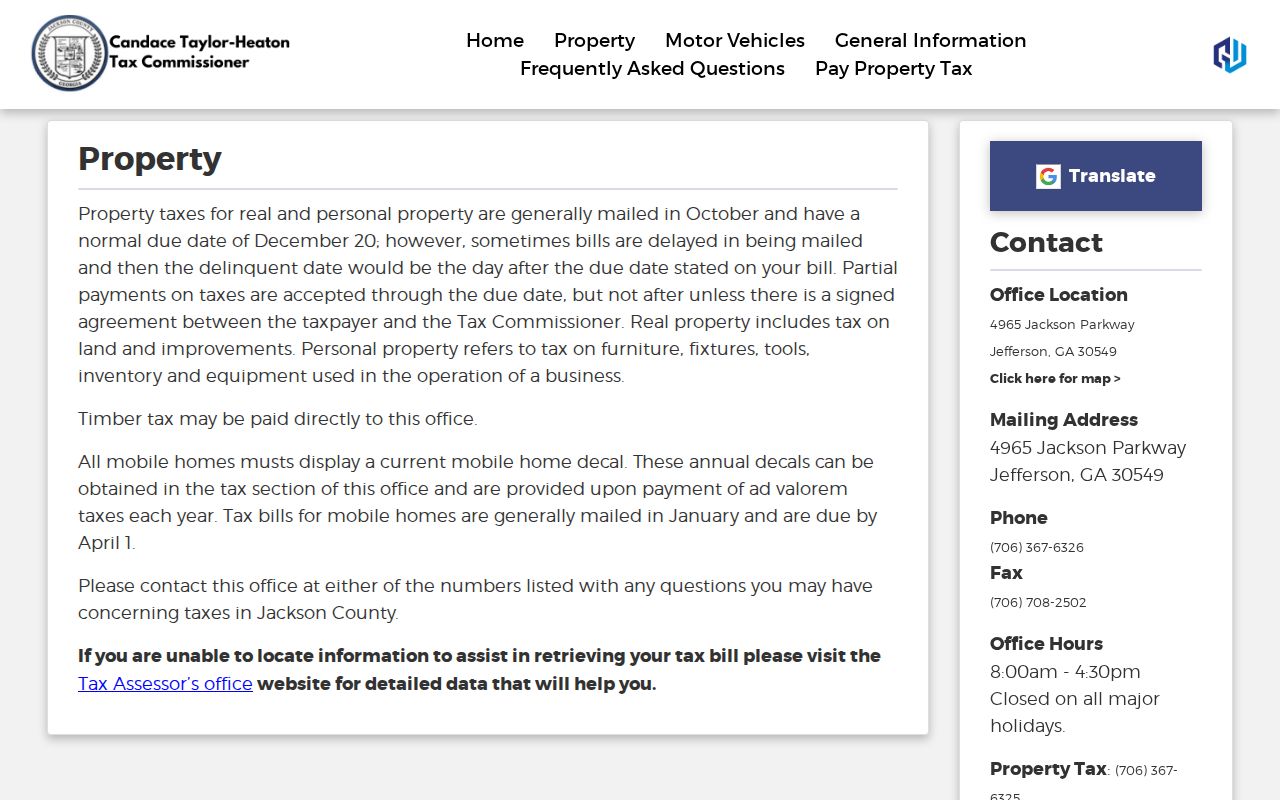
The Tax Commissioner's page identifies the billing channel for Jackson County. You still need a selected account and year before any bill-specific answer appears.
Look Up a Jackson County Bill
Copy the parcel number from qPublic first. That single key prevents errors from mailing-address changes and repeated owner names across Jackson County. Without the APN, run a physical address or owner query, open a candidate account, and match the legal description before trusting any balance shown.
- Find the APN in qPublic, or select owner or location in the bill search.
- Choose the correct roll type and tax year. A current question needs a current bill.
- Match the owner, location, parcel, and district before reading the amount or status.
- Check exemptions on the assessor record and use the date printed on the bill.
- Assessed value
- The statutory percentage used as the base before allowed exemptions.
- Mill rate or levy
- The rate applied to taxable value; one mill is one dollar per thousand dollars.
- Homestead exemption
- A qualifying reduction tied to an owner's primary home and application.
- Tax lien
- A claim tied to unpaid tax, not the same item as the yearly bill.
Jackson County mails most property tax bills in October. December 20 is the standard due date. If bills run late, the date printed on the bill controls. Keep the bill year beside any receipt or delinquency record you pull.
Separate Jackson County Tax Values
Fair-market value is the assessor's estimate under Georgia valuation law. Assessed value is normally 40 percent of that figure. Exemptions or a preferential program can shift taxable value yet again. Keep land and improvement fields separate where they appear. Read every exemption flag against its stated tax year.
A prior sale never sets the next bill by itself. The deed or PT-61 may supply transaction context, and qPublic may show a last-sale reference. Neither one is a fresh appraisal. So never back into a sales price from assessed value. Never assume the sale and owner fields refresh on the same schedule.
Jackson County's Annual Tax Cycle
Jackson County's tax year starts with whoever owned the parcel on January 1. Property returns come in between January 1 and April 1. After April, assessment notices go out once the board makes a value change. Nothing in this cycle guarantees timing. A deed recorded on a given date may not show up in qPublic within any set number of days.
An owner or value looks wrong. Write down four dates. Record the assessment year, the notice date, the deed recording date, and the date you searched. Comparing them shows the actual lag for that one parcel. Ask which roll date is live. The Tax Assessors' office can say. Don't assume a 30-day, 60-day, or 90-day update window.
Note: Jackson County reviews parcels on a set schedule. Each is reviewed at least once every three years. That cycle runs within an annual valuation and notice system.
Jackson County Exemption Records
Why do two Jackson County parcels with similar fair-market values carry different taxable bases? Often an exemption explains it. Homestead and other Georgia programs hinge on eligibility, filing, and parcel facts. Conservation, agricultural, historic, and similar preferential programs can also change how land is assessed. Any exemption flag must be tied to its year.
Tax Assessors run the exemption side of Jackson County property tax records. Their office sits at 4965 Jackson Parkway in Jefferson, reachable at 706-367-6330. Ask for the current form, eligibility rule, and filing date before acting. A bill screen alone rarely explains why a reduction was allowed, removed, or changed.
Jackson County Bill Timing
The notice and the bill answer different questions. An assessment notice states a proposed or changed value and opens the appeal period. The bill comes later. It applies the district rates to the account's status. A late bill can carry a printed due date that overrides the usual calendar. So read the document instead of trusting a general rule.
Complications pile up quickly. Partial payments, mobile-home accounts, corrections, and appeal-related temporary bills each add a layer. An appeal may be pending. A temporary bill may then use 85 percent of the prior year's value or the taxpayer's returned value under the applicable rule. Confirm the figure with the Tax Commissioner rather than guessing from qPublic.
Jackson County Delinquent Tax Clues
A past-due tax bill and a completed tax sale are different records. Start with the Tax Commissioner to confirm the account status. Then search the clerk's deed records. Look for a tax deed, FiFA, release, or any other recorded instrument tied to the parcel. Legal notices and court files can add context. They never replace the official bill or the transfer document itself. Jackson County publishes no current online tax-sale list or calendar. Do not infer a sale date from a stale search result or a mailed offer. Call 706-367-6325 for billing status and 706-387-6246 for a recording question. Before treating an old lien as active, check the deed records for a later release or cancellation.
Appeal a Jackson County Assessment
Jackson County gives owners 45 days to appeal a changed assessment. That clock starts with the notice, not the October bill. Build the file early. Gather the notice, the parcel card, photographs, and comparable sales. Add deed details, maps, and any condition evidence that supports the disputed point.
Through the Board of Equalization process, the assessor reviews the appeal. If needed, a hearing follows. Read the hearing notice as soon as it arrives. An unresolved case may proceed to Superior Court. Keep proof of filing, and confirm which value a temporary bill will use.
The county's assessment appeal page lays out the full local route.
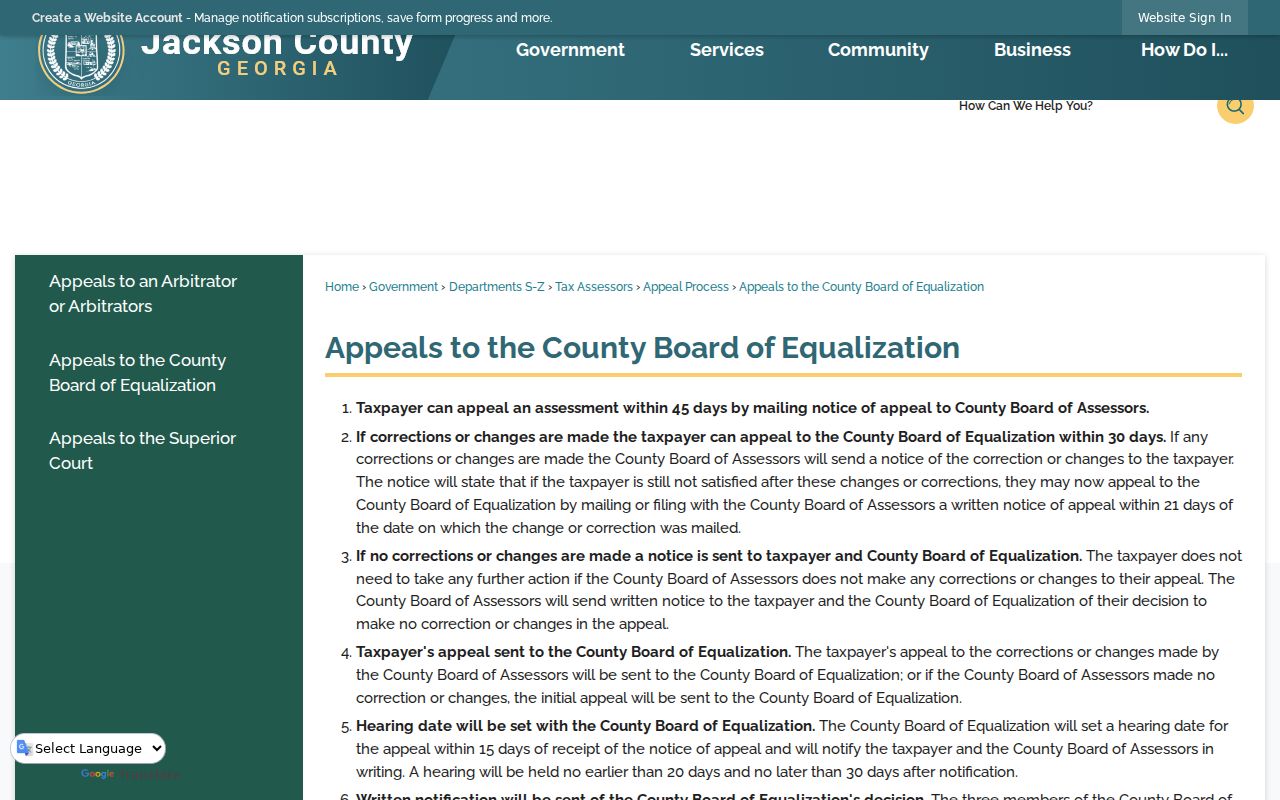
The notice date, not any web page, controls the appeal window.
Appeal window. File within 45 days of the assessment notice and keep proof of delivery. A phone call does not by itself preserve the appeal.
Pin down the exact issue before appealing. A wrong physical detail, an omitted condition, a disputed land classification, unequal treatment, or a market-value concern each calls for different proof. Save the parcel card from the day of the property search, the full notice, dated photos, the relevant deed or plat pages, and comparable records that genuinely match the property type and location.
After filing, watch the mail. Each county notice gives the next date. Ask whether a correction has been proposed and which value a temporary bill shows. Payment and appeal run on separate tracks. Paying the amount required for the year does not settle the valuation dispute, and an open appeal does not erase every payment duty.
Some disputes involve an owner name or a transfer date rather than value. For those, compare the January 1 tax status against the newest deed. Route a recording error to the clerk. Send a roll-display issue to Tax Assessors. Keeping these questions apart prevents a missed appeal while the offices sort out the underlying record.
Keep the final decision with that year's bill. A later parcel screen may show the revised value. But it may not preserve each step behind it. The notice, the appeal, the hearing result, and the tax receipt together make the stronger dated file.